
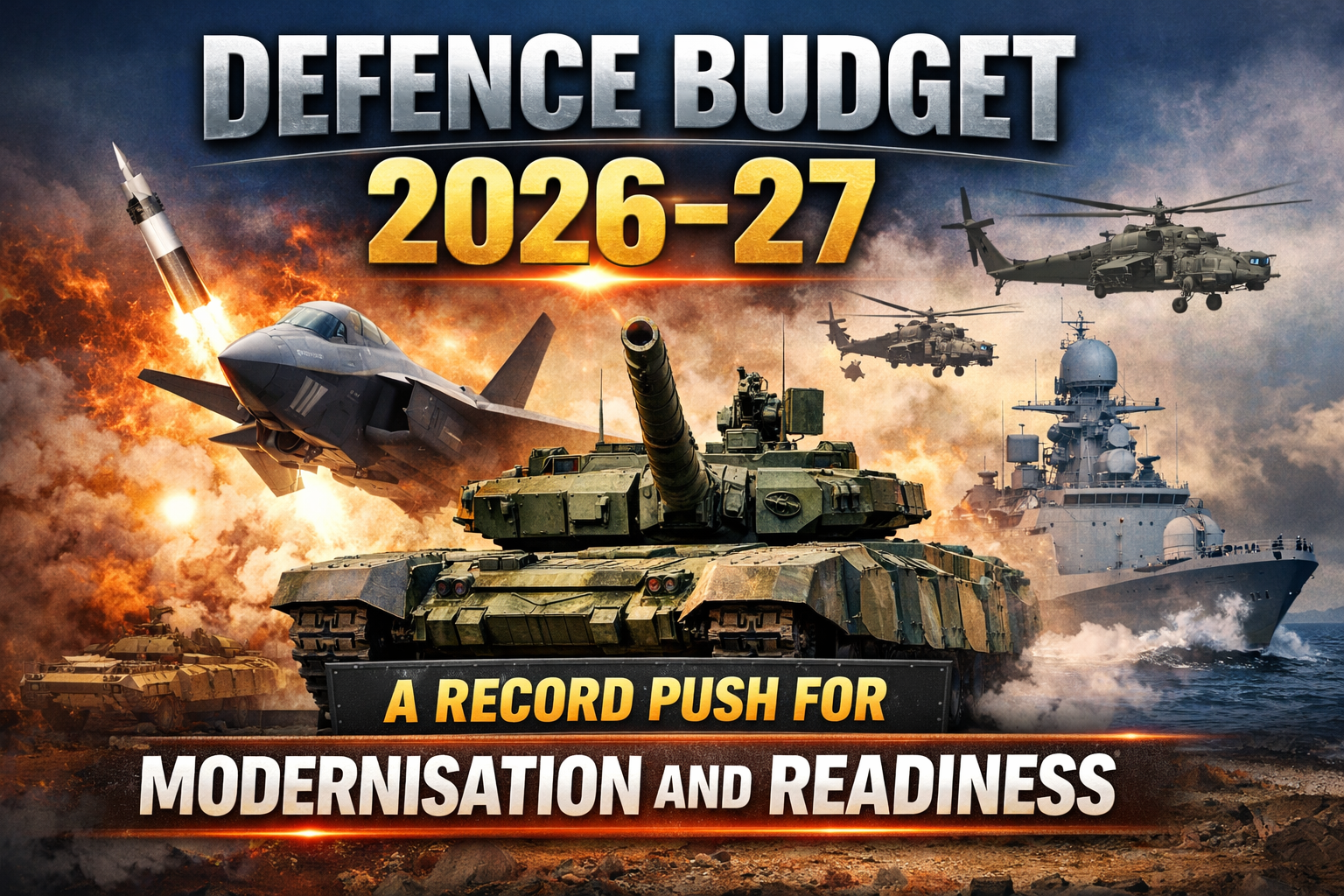
India’s Defence Budget for FY 2026–27 marks a significant milestone in the country’s military modernisation journey. With a total allocation of ₹7.85 lakh crore, the budget sends a strong signal of the government’s intent to strengthen both operational readiness and future warfighting capabilities.
The most notable highlight is the record capital outlay of ₹2.19 lakh crore for modernisation, with capital acquisition accounting for approximately ₹1.85 lakh crore. This reflects a clear shift toward long-term capability building across all three services.

Key Budget Highlights
- Total Defence Budget: ₹85 lakh crore
- Capital Outlay (Modernisation): ₹19 lakh crore
- Defence Pensions (Gross): ₹79 lakh crore
Where Is the Money Going?
The defence budget can broadly be understood across three major components:
- Defence Services (Revenue): Covers salaries, fuel, spares, repairs, training, and day-to-day operational readiness.
- Capital Outlay: Funds new acquisitions—aircraft, ships, submarines, missiles, artillery, sensors, networks, and infrastructure.
- Defence Pensions: Includes OROP, service pensions, family and disability pensions, and gratuity. The implementation of the Agniveer Scheme aims to moderate long-term pension liabilities.
For FY 2026–27:
- Defence Services (Revenue): ~₹65 lakh crore
- Capital Outlay: ₹19 lakh crore
- Defence Pensions (Gross): ₹79 lakh crore
The message is unambiguous: operational preparedness and modernisation are being pursued simultaneously.
What Does “Modernisation” Really Mean?
Modernisation is not merely about buying new platforms. It is about closing capability gaps for potential double-front conflict scenarios. This includes:
- Air Power: Fighters, helicopters, engines, radars, electronic warfare systems
- Naval Power: Submarines, surface combatants, maritime surveillance assets
- Land Power: Artillery, air defence, drones, precision-guided munitions
- Network-Centric Warfare: Secure communications, spectrum, satellites, sensors
- Indigenisation: Strengthening Make-in-India supply chains for spares, ammunition, and systems
The rise of capital outlay to ₹2.19 lakh crore represents a substantial jump over the previous year, underlining the focus on future capabilities. In simple terms, capital outlay equals future weapons, platforms, and military infrastructure.
Air Force Impact: Fighters, Engines, and Air Defence: One of the most visible allocations is ₹63,733 crore for aircraft and aero-engines. The expected impact includes:
- Faster delivery pipelines, upgrades, and better fleet support
- Improved engine availability, leading to higher sortie rates and readiness
- Enhanced survivability through advanced radars, electronic warfare pods, and self-protection suites
Importantly, aircraft expenditure extends beyond the platform itself—it also supports training, simulators, weapons integration, and maintenance ecosystems.
- ₹63,733 crore: Aircraft and Aero Engines
- Expected Outcome: Higher availability, faster upgrades, stronger deterrence
It is worth noting that budget allocation provides capability headroom; actual platforms and variants depend on subsequent procurement approvals and contracts.
Navy Impact: Ships, Submarines, and Maritime Dominance: The Navy receives a clear capital push with ₹25,023 crore allocated for fleet strengthening. This supports:
- Acceleration of shipbuilding and refit programmes
- Enhanced maritime surveillance and coastal security
- A sharper focus on undersea warfare, including submarines, sensors, and anti-submarine capabilities
Given the strategic importance of the Indian Ocean Region—sea lanes, energy security, and the presence of hostile naval forces—this allocation is critical for future conflict scenarios.
Army Impact: Guns, Drones, Air Defence, and Networks: The Army’s revenue allocation of ₹2.43 lakh crore forms the backbone of daily readiness. However, decisive warfighting improvements will emerge from capital acquisitions:
- Drones and counter-drone systems for surveillance and strike
- Layered air defence combining guns, missiles, and radars
- Precision fires through guided artillery, rockets, and smart ammunition
- Secure communications and spectrum for network-centric operations
Soldier-level impact on the ground includes:
- Better ISR reducing ambush risks
- Enhanced night-fighting and drone-enabled patrols
- Reduced threat from enemy drones and munitions
- Improved availability of spares and ammunition
R&D, DRDO, Missiles, and Drones: Preparing for Future Wars: Defence R&D funding flows through two main channels:
- R&D line items within Defence Services (revenue)
- Ministry of Defence (Civil) initiatives—DRDO, iDEX, ADITI, testing infrastructure, and defence corridors
This investment is crucial for:
- Missile and air defence systems
- Drone and anti-drone technologies, AI-enabled surveillance
- Electronic warfare and cyber resilience
- Scaling up indigenous production
The strategic message is clear: “Buy, Build, and Innovate” will move forward together.
Welfare and Housing: Supporting Soldiers and Families: Defence capability is not limited to weapons alone. Housing and welfare allocations under MoD (Civil), along with investments in defence estates, cantonments, border roads, the Coast Guard, and tribunals, directly impact morale and readiness.
As often stated, morale is a capability multiplier.
Double-Front War Readiness: Is the Budget Enough?
The government has delivered a strong modernisation signal with record capital allocations. However, real readiness will depend on execution in three critical areas:
- Speed of procurement and contract finalisation
- Depth of indigenisation across spares, ammunition, and engines
- Rapid training and integration of new technologies at unit level
If execution keeps pace, India can expect a tangible capability jump across fighters, ships, missiles, drones, and air defence systems.
The story of Defence Budget 2026–27 is one of decisive intent:
- A major push for modernisation
- Strong support for air, naval, and land capabilities
- A growing R&D and innovation ecosystem
- Balanced attention to welfare, morale, and readiness
The budget lays the foundation. The coming years will determine how effectively this intent translates into credible deterrence and combat power.