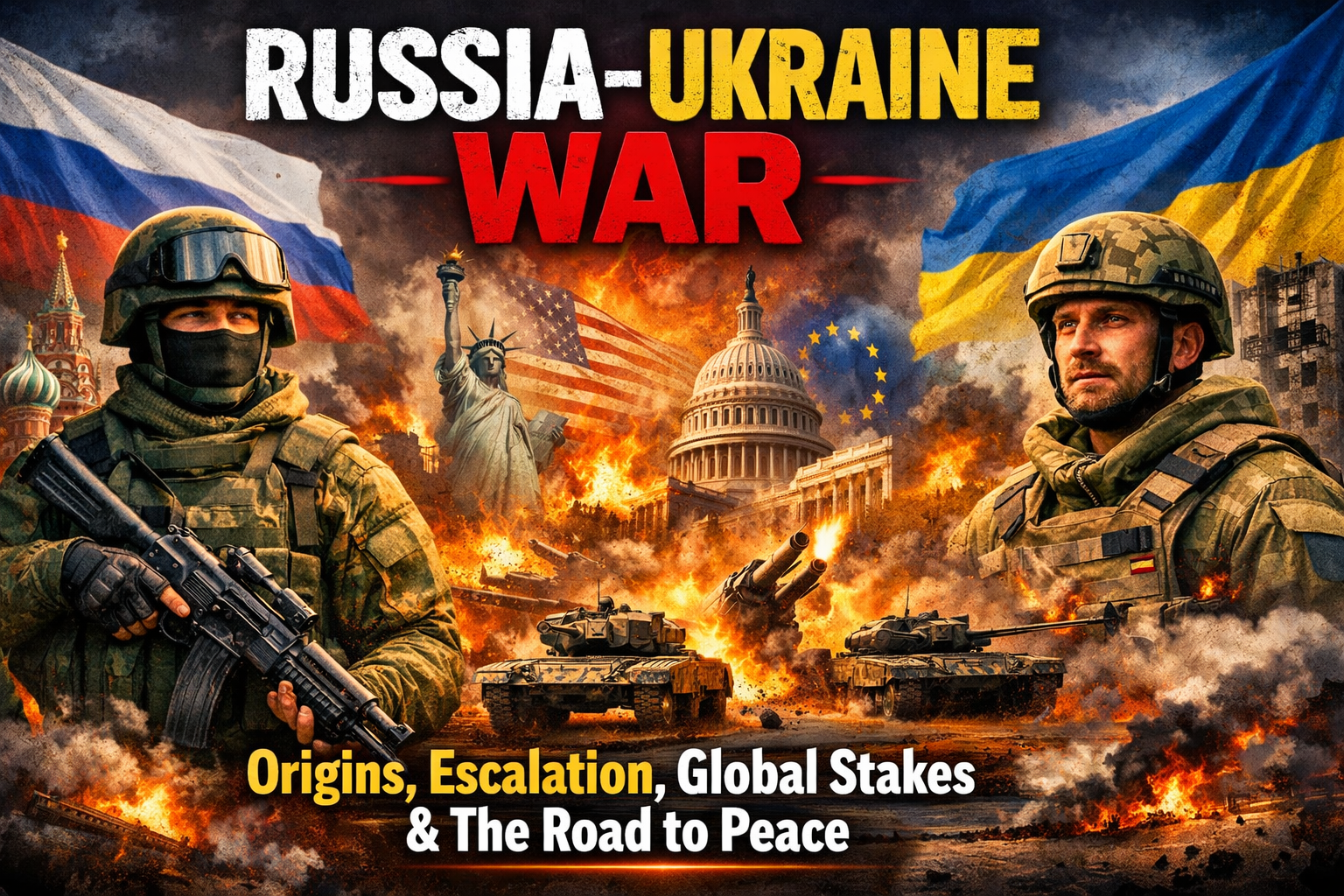
The Russia–Ukraine war is widely regarded as the most significant military conflict in Europe since World War II. Russia launched a full-scale invasion on 24 February 2022, dramatically escalating a conflict that had already begun in 2014 after Moscow annexed Crimea.
The war has triggered massive humanitarian suffering, geopolitical confrontation, and economic disruption across the globe. Millions have been displaced, and the conflict has reshaped the security architecture of Europe.
Origin of the Conflict (2014–2021)
Political Upheaval in Ukraine: The crisis traces back to the Euromaidan protests, which led to the removal of Ukraine’s pro-Russian president Viktor Yanukovych. Soon afterward, Russian forces occupied Crimea and annexed it following a disputed referendum.
Russia also supported separatist movements in eastern Ukraine’s Donbas region, initiating an armed conflict that lasted eight years before the 2022 invasion.
Competing Strategic Visions:
- Ukraine increasingly sought closer ties with the West and NATO.
- Moscow demanded that NATO halt expansion and withdraw allied troops from Eastern Europe.
These opposing security visions created a deep strategic fault line.
Conflict Drivers (Pie Representation):
Security concerns (Russia) ████████████ 30%
Ukraine-West alignment ██████████ 25%
Historical & territorial claims ███████ 15%
Internal Ukrainian politics ██████ 10%
Great-power rivalry █████████ 20%
(Conceptual distribution based on strategic analyses.)
Why Did Russia Invade in 2022?
Scholars disagree on the main trigger:
- Some argue the Kremlin was motivated by fears of NATO expansion along its borders.
- Others contend the West’s lack of strategic clarity and deterrence encouraged Russian assertiveness.
Most analysts now see the war as driven by a combination of security fears, power politics, and regional influence.
Human and Military Cost: The war’s toll has been staggering:
- Russian casualties could reach one million, while Ukrainian casualties since 2022 are estimated at about 400,000, including 60,000–100,000 killed.
- Russian troops occupy nearly 20% of Ukraine.
- Around 6–7 million people have fled the country, with millions more internally displaced.
Civilian suffering continues; over 53,000 civilian casualties and millions displaced have been reported.
Humanitarian Impact Diagram:
Population displaced: ██████████████████
Infrastructure damage: ███████████████
Military casualties: ███████████
Economic disruption: █████████████
Role of Internal Forces:
Ukraine
- The invasion unified many Ukrainians around closer Western integration.
- National identity strengthened as resistance grew.
Russia
- Moscow views Ukraine as part of its historical sphere of influence.
- Strategic depth and buffer zones remain central to Russian military doctrine.
Role of Neighboring Countries:
- Belarus allowed Russia to use its territory to launch the invasion.
- Poland and Eastern European states became major logistical hubs for aid and refugees.
Regional tensions have increased, transforming Eastern Europe into a heavily militarized zone.
Role of NATO and Western Powers: NATO cooperation with Ukraine intensified after Crimea’s annexation.
Western countries enhanced military presence in Eastern Europe under deterrence initiatives such as Operation Atlantic Resolve.
The EU has repeatedly reaffirmed support for Ukraine’s sovereignty and territorial integrity.
However, debate continues over whether Western actions deterred or provoked Moscow.
China and Other External Actors: Recent diplomacy highlights shifting alliances:
- Russia has strengthened ties with China amid Western sanctions.
- Allegations persist that China provides military support, though Beijing denies it.
The war increasingly resembles a broader geopolitical contest.
Present Situation (2026):
- Russian missile and drone attacks continue despite temporary ceasefires.
- Massive strikes have damaged energy infrastructure, leaving thousands without heat during winter.
Peace Talks: U.S.-mediated negotiations are underway in Abu Dhabi to end the nearly four-year war.
Major sticking points include:
- Russia demanding Ukraine cede the Donbas region.
- Ukraine insisting on European troop deployments for security guarantees.
These positions remain far apart.
Trump, Europe, and Diplomacy: Recent developments indicate:
- A Trump-brokered ceasefire was limited and temporary.
- European leaders are preparing counter-proposals to U.S. peace plans.
The transatlantic alliance itself is debating how to end the war without rewarding aggression.
Is Either Side Solely Responsible?
Modern wars rarely stem from one leader’s decisions alone. Analysts highlight multiple “blades of a scissors”—internal and external factors driving escalation.
Thus, attributing devastation purely to one individual oversimplifies a complex geopolitical struggle.
How Can Relations Improve? (Strategic Recommendations)
- Security Guarantees Without Immediate NATO Membership
A neutral or security-guaranteed Ukraine could address Russian fears while preserving Ukrainian sovereignty.
- Phased Territorial Negotiations
Freeze battle lines temporarily while pursuing long-term diplomatic settlement.
- Arms Control Framework
Revive Cold War–style agreements on missiles and troop deployments.
- Multilateral Peacekeeping
A UN-mandated or broadly accepted force could monitor ceasefires.
- Economic Reconstruction Pact
A “Marshall Plan–type” rebuilding strategy could incentivize peace.
- Direct Leadership Dialogue
Sustained leader-level negotiations remain essential.
Possible Future Scenarios:
- Frozen Conflict: Front lines stabilize but no peace treaty emerges.
- Negotiated Settlement: Requires painful compromises from both sides.
- Escalation: Continued strikes risk broader confrontation involving NATO.
- Strategic Stalemate: War drags on with high economic cost globally.
The Russia–Ukraine war is not merely a bilateral conflict; it represents a clash between competing visions of European security and global order. Millions have suffered, economies have been disrupted, and geopolitical divisions have deepened.
Peace will likely require:
- Recognition of legitimate security concerns
- Respect for sovereignty
- International guarantees
- Political courage from all sides
Ultimately, sustainable peace cannot be built on military victory alone—it must rest on diplomacy, compromise, and a shared commitment to preventing future wars.