
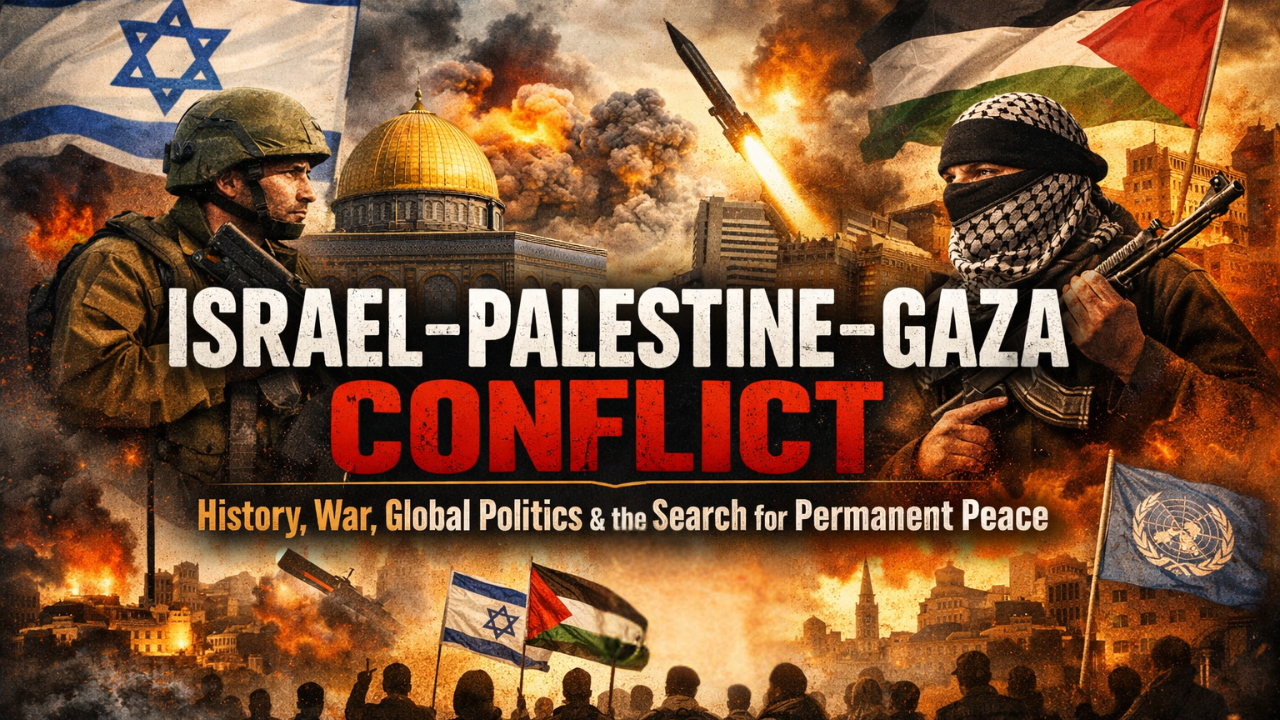
The Israel–Palestine conflict is one of the world’s longest-running and most emotionally charged geopolitical disputes. Rooted in competing national identities, religious significance, territorial claims, and historical grievances, the conflict has repeatedly erupted into wars that have shaped Middle Eastern politics for decades.
The latest large-scale war began after the October 7, 2023 attack by Hamas that killed about 1,200 Israelis, triggering a devastating Israeli military campaign in Gaza that has displaced millions and destroyed vast infrastructure.
Despite ceasefires and international mediation, violence continues. Israeli strikes in February 2026 killed civilians including children, while the fragile truce remains under threat.

This article explains the origin, evolution, causes, global involvement, losses, and possible pathways to lasting peace.
Historical Background: Seeds of Conflict
- Ottoman Era to British Mandate
For centuries, Palestine was part of the Ottoman Empire. After World War I, Britain governed the territory.
Two nationalist movements emerged:
- Zionism: Advocated a Jewish homeland.
- Arab nationalism: Opposed large-scale Jewish migration.
Rising tensions led to violence even before Israel’s creation.
- Creation of Israel (1948) — The Turning Point
When Israel declared independence in 1948:
- Neighboring Arab states attacked.
- Hundreds of thousands of Palestinians fled or were displaced.
For Palestinians, this event is remembered as the “Nakba” (catastrophe).
- Wars and Occupation
Major developments that hardened positions:
- 1967 Six-Day War: Israel captured Gaza, West Bank, and East Jerusalem.
- Expansion of Israeli settlements.
- Palestinian uprisings (Intifadas).
These events created enduring mistrust.
Evolution into the Gaza Conflict
Rise of Hamas
Hamas emerged in the late 1980s and later controlled Gaza.
Israel views Hamas as a militant organization threatening its security, while many Palestinians see it as resistance.
Blockade and Recurrent Wars
Israel imposed restrictions on Gaza after Hamas took power.
Result:
- Economic hardship
- Humanitarian crises
- Periodic wars
Immediate Trigger of the Current War
The 2023 Hamas attack shocked Israel and led to a massive military response.
Since then:
- Tens of thousands of Palestinians have been killed.
- Over 2 million residents were displaced.
Infrastructure damage has been enormous, with hospitals overwhelmed and homes destroyed.
Why Does This Conflict Persist? (Core Causes)
Conflict Drivers (Conceptual Pie)
Territorial disputes █████████████ 30%
Security fears ███████████ 25%
Religious significance ████████ 15%
Political extremism ███████ 15%
External interference █████ 10%
Historical trauma ████ 5%
Key Causes Explained
✔ Competing claims over land
✔ Jerusalem’s religious importance
✔ Security vs sovereignty debate
✔ Refugee question
✔ Radicalization and mistrust
Escalation into Full-Scale War
The conflict intensified repeatedly:
- Ceasefires collapsed after large airstrikes killed hundreds.
- Israel resumed ground operations and took operational control of key zones such as Rafah.
Even hospitals were hit during strikes that killed dozens.
This illustrates how quickly tensions spiral into major warfare.
Role of Superpowers and External Forces
United States
- Major military and diplomatic supporter of Israel.
- Led a multilateral Gaza peace plan aimed at ending the war and rebuilding the region.
However, reconstruction funding is stalled due to concerns about Hamas disarmament.
Arab States
Countries like Egypt and Qatar have mediated ceasefires.
Iran
Widely seen as backing anti-Israel groups — increasing regional polarization.
Europe
Supports humanitarian aid but is divided on military and political strategy.
International Peacekeeping Efforts
An UN-mandated International Stabilization Force was proposed to:
- Provide security
- Train Palestinian police
- Oversee demilitarization and redevelopment
Such measures indicate global recognition that the crisis cannot be solved militarily.
India’s Stand
India traditionally supports:
✔ A two-state solution
✔ Israel’s security
✔ Palestinian statehood
In recent years, India has balanced relations — strengthening ties with Israel while continuing humanitarian support for Palestinians.
This strategic neutrality reflects India’s broader foreign policy approach.
Losses and Gains
Palestinian Side — Losses
- Massive civilian casualties
- Displacement
- Economic collapse
- Infrastructure destruction
Israeli Side — Losses
- Civilian deaths from attacks
- Hostage crisis
- Economic strain
- Constant security threats
Strategic Gains?
Some analysts argue:
- Israel reasserted military dominance.
- Hamas demonstrated operational capability despite heavy losses.
But the reality is stark: No real winners — only prolonged suffering.
Humanitarian Impact Diagram
Civilian casualties █████████████████
Displacement ███████████████
Infrastructure loss ███████████
Economic damage █████████████
Psychological trauma ███████████████
Present Situation (2026)
- Ceasefires remain fragile.
- Border crossings operate intermittently.
- Civilians report traumatic conditions during movement and security checks.
The region remains a tinderbox.
Major Obstacles to Peace
- Lack of trust
- Extremist factions
- Political polarization
- Settlement disputes
- Leadership pressures
- Foreign strategic interests
Pathways Toward Permanent Settlement
- Two-State Solution Revival
Separate sovereign states remain the most widely proposed framework.
- Demilitarization with Security Guarantees
Both sides need credible assurances.
- International Administration of Gaza
Temporary global governance could stabilize the region.
- Economic Reconstruction
Jobs and development reduce radicalization.
- Direct Dialogue
Peace requires negotiation — not isolation.
- Regional Cooperation
Middle Eastern powers must support diplomacy instead of proxy rivalry.
Strategic Recommendation Framework
Immediate ceasefire
↓
Hostage & prisoner resolution
↓
International peacekeeping
↓
Reconstruction
↓
Political settlement
↓
Permanent borders
Future Scenarios
✔ Negotiated Peace
Painful compromises but long-term stability.
✔ Frozen Conflict
Violence reduces but tension persists.
✔ Regional War
Risk if Iran or other actors escalate.
✔ Endless Cycle
Periodic wars without resolution.
The Israel–Palestine conflict is not merely a territorial dispute — it is a collision of history, faith, identity, and geopolitics.
Military victories may change maps temporarily, but lasting peace can only emerge through political courage, compromise, and international cooperation.
The greatest lesson is simple: War destroys generations — peace builds civilizations.
Until both sides accept coexistence over confrontation, the dream of a stable Middle East will remain elusive.