
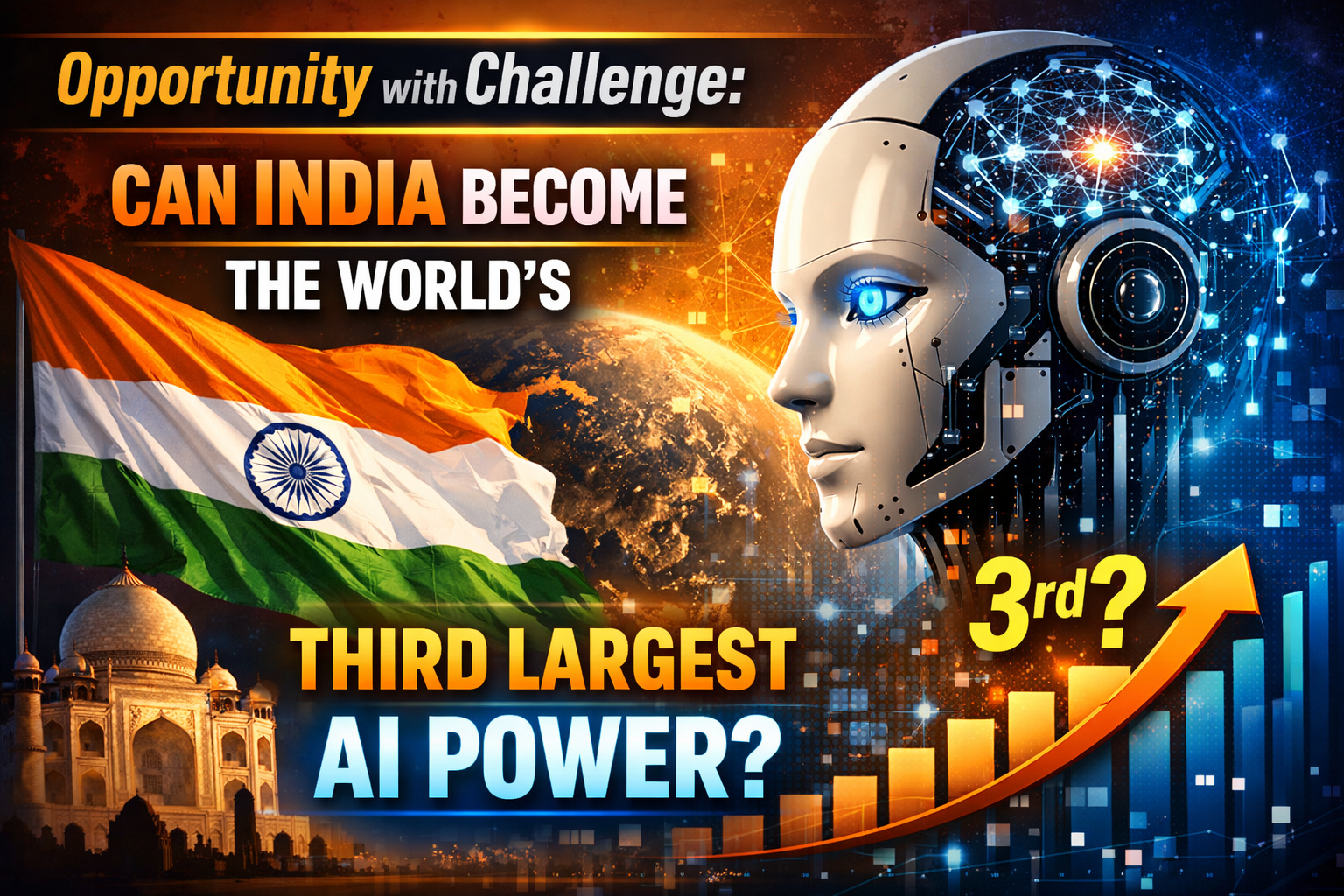
Artificial Intelligence (AI) is no longer just a technological innovation; it has become the defining force shaping the 21st century. Much like the Industrial Revolution transformed economies in the past and the Digital Revolution redefined communication and commerce, the AI revolution is now reshaping governance, defense, healthcare, education, and global geopolitics. Nations that lead in AI will not only dominate economically but will also wield strategic and military influence.
Today, the global AI race is primarily led by the United States and China. In the United States, companies such as OpenAI, Google, and Microsoft are pioneering breakthroughs in generative AI, cloud AI infrastructure, and large language models. China, on the other hand, has strategically integrated AI into national planning, investing heavily in surveillance systems, manufacturing automation, and military AI applications.
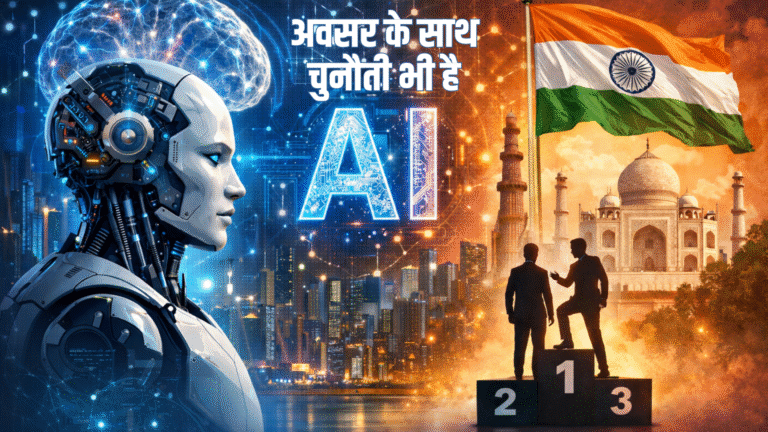
Amid this competitive global landscape, India is preparing to emerge as the world’s third-largest AI power. However, aspiration alone is insufficient. India can only claim such a position when its AI companies stand shoulder-to-shoulder with global leaders in innovation, research, investment, and scalability.
India’s Strengths: A Strong Foundation for AI Growth
India possesses several structural advantages that make it uniquely positioned to advance in AI.
- Demographic Dividend
India has one of the youngest populations in the world. Every year, hundreds of thousands of engineers, programmers, and data scientists graduate from Indian institutions. This large and dynamic talent pool is a strategic asset in the AI era.
- Expanding Digital Infrastructure
India has successfully built one of the world’s largest digital ecosystems. Platforms such as Aadhaar, UPI, digital governance services, and the rapid expansion of internet connectivity have created massive data streams. Since data is the fuel for AI, India already holds a significant advantage in terms of scale and diversity of datasets.
- IT Expertise and Global Integration
Indian IT professionals are deeply embedded in global technology ecosystems. Many leading engineers and executives in Silicon Valley are of Indian origin. This exposure provides India with access to global best practices, advanced research culture, and international collaboration opportunities.
Opportunities for India in AI
AI offers transformative potential across multiple sectors in India.
Agriculture
AI-driven weather forecasting, soil health analysis, pest detection, and precision farming can significantly enhance agricultural productivity and farmers’ incomes.
Healthcare
AI-powered diagnostics can detect diseases such as cancer and cardiovascular conditions at early stages. Telemedicine combined with AI analytics can bring specialized healthcare services to rural and remote regions.
Education
Personalized learning platforms can adapt to individual student needs, helping bridge educational disparities. AI tools in regional languages can democratize knowledge access.
Defense and National Security
AI can strengthen cyber defense, surveillance systems, drone technology, and battlefield intelligence. In a rapidly evolving geopolitical environment, AI-enabled defense systems are critical for strategic autonomy.
Governance and Public Policy
Data analytics and predictive modeling can improve public service delivery, disaster management, and policy decision-making.
If strategically implemented, AI can accelerate India’s economic growth and social development simultaneously.
Key Challenges India Must Address
Despite strong potential, significant challenges remain.
- Semiconductor and Hardware Dependency
AI systems require advanced chips and high-performance computing infrastructure. Currently, semiconductor manufacturing is concentrated in a few countries. India must develop domestic capabilities to ensure technological sovereignty.
- Scale of Investment
AI research and model development require billions of dollars in sustained investment. American tech giants invest heavily in AI research, data centers, and computing power. Indian companies and policymakers must adopt a long-term investment vision.
- Talent Retention and Brain Drain
A large number of India’s brightest minds work abroad. Creating world-class research ecosystems, competitive compensation, and strong innovation environments will be crucial to attract and retain talent.
- Data Privacy and Ethical Concerns
AI systems can be misused through deepfakes, misinformation campaigns, algorithmic bias, and cyber threats. India must develop strong ethical frameworks and regulatory safeguards to ensure responsible AI use.
Strategic Steps for India’s AI Leadership
To emerge as the third-largest AI power, India must pursue a clear and coordinated strategy:
- Develop indigenous AI models tailored to Indian contexts and languages.
- Invest aggressively in semiconductor manufacturing and data center infrastructure.
- Integrate AI education at school and university levels.
- Foster strong public-private partnerships for research and commercialization.
- Create robust regulatory frameworks ensuring ethical and secure AI development.
Special emphasis should be placed on multilingual AI systems. India’s linguistic diversity can become a global advantage if leveraged effectively.
Vision 2047: AI-Powered India
As India approaches its centenary of independence in 2047, technological leadership must become a national aspiration. AI should not merely be a tool for consumption but a platform for innovation and global influence.
Imagine an India where:
- Indigenous AI platforms compete globally.
- Indian data centers power advanced computing.
- AI transforms agriculture, healthcare, education, and governance.
- Indian startups become global AI champions.
This vision is achievable—but only with determination, coordinated policy, and bold investment.
Conclusion
Artificial Intelligence presents India with a historic opportunity. However, opportunity always comes with challenge. If India remains merely a consumer of foreign AI technologies, it may become a large market but not a global leader.
To become the world’s third-largest AI power, India must shift from consumption to creation, from dependency to self-reliance, and from ambition to action. The AI race is not just about technology; it is about economic strength, strategic autonomy, and global influence.
The future will belong to nations that not only adopt technology but shape it.
The AI era has arrived—India must now decide whether it will watch history unfold or write it.
Jai Hind.


 Born To Win A Tale Of Belief And Grit