
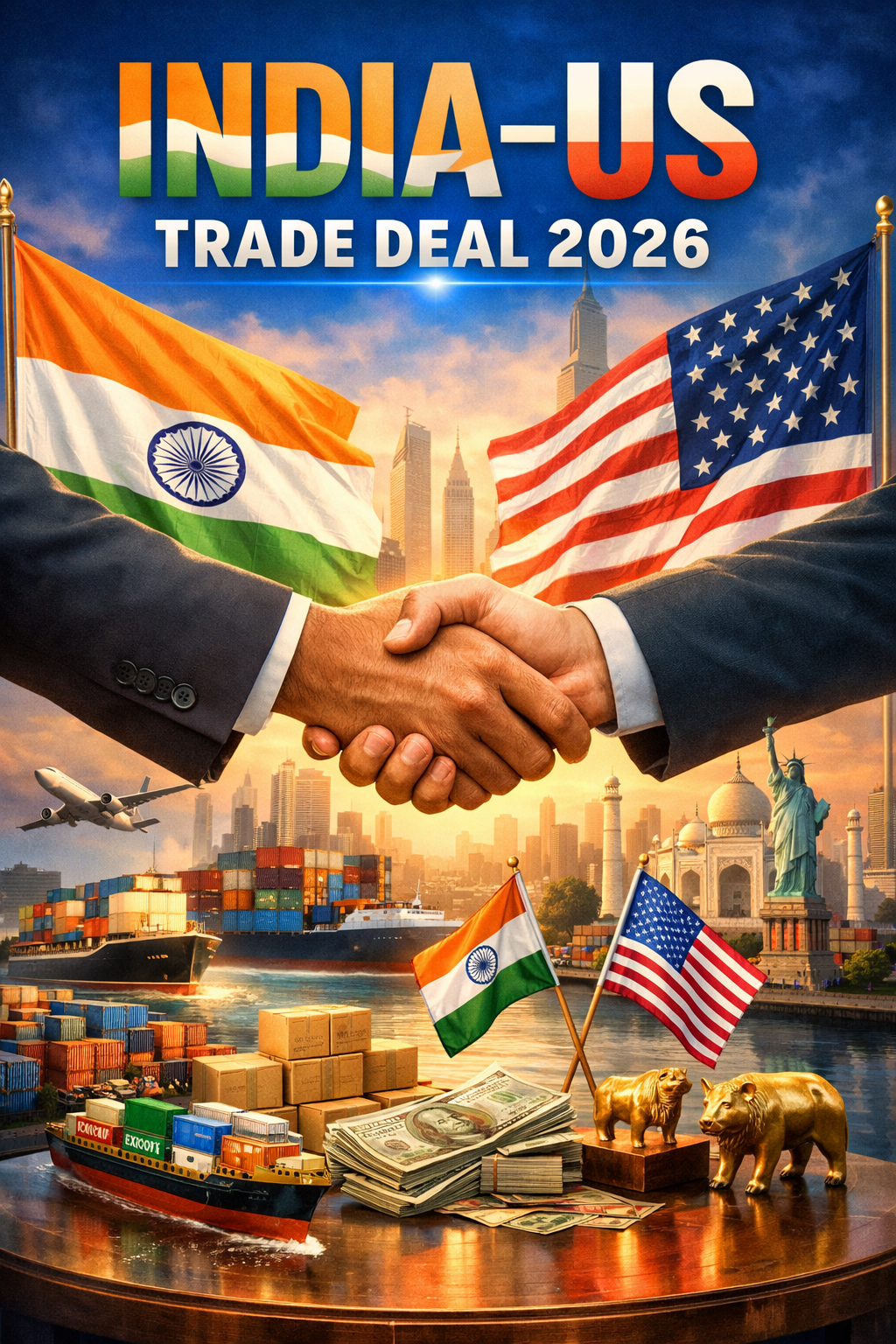
India and the United States have recently finalized a trade agreement under which US tariffs on Indian goods are reduced sharply — from punitive levels near 50% to about 18%.
This deal comes after tensions in 2025 when high tariffs were imposed due to India’s purchase of Russian oil.
In return, India is expected to stop buying Russian oil and increase purchases of US energy, technology, and agricultural products.
Think of it like this:
Earlier: Indian products became expensive in America → orders fell.
Now: Prices drop → exports can rise again.
Deal Explained with a Simple “Pie-style” Breakdown
What India Gets (Benefits)
Export Boost:
- Labour-intensive sectors like apparel, footwear, jewellery and chemicals will gain relief from earlier punitive tariffs.
- Tariff reduction restores India’s price advantage over competitors like Vietnam and Bangladesh, which face around 20% duties.
Huge Competitive Advantage:
- Trade-weighted tariffs dropped by nearly 64%, strengthening India’s global position.
Job Protection:
- Earlier 50% tariffs had stalled exports and threatened thousands of jobs.
Relief on ~$48 billion exports heading to the US market.
Pie Representation – India’s Gains
Exports growth potential ██████████ 40%
Global competitiveness ████████ 25%
Job protection █████ 15%
Investor confidence ████ 10%
Strategic ties with US ███ 10%
What India Gives / Possible Losses
Energy Dependence Shift: India reportedly agreed to stop buying Russian oil and buy more from the US.
This may increase costs if US energy is pricier.
Opening Indian Market: Trump claimed India will reduce tariffs and non-tariff barriers for US goods to “zero.”
Risk: American products could compete strongly with Indian manufacturers.
Massive Purchase Commitment: India may buy over $500 billion of US goods in coming years.
That is both cooperation — and dependency.
Policy Uncertainty: Experts still lack clarity on whether the 18% tariff is final or stacked over existing duties.
Pie Representation – India’s Risks
Energy dependence ████████ 30%
Market opening to US ██████ 25%
Large import commitments █████ 20%
Policy uncertainty ████ 15%
Strategic autonomy concerns ██ 10%
Diagram — Before vs After
US Tariffs on Indian Goods
Before 2025 escalation: ~25–30%
After penalties: ~50%
NOW (Deal): 18%
Result → India back in global cost competition.
Impact on the Common Indian
Positive
- More exports → more factory jobs
- Stronger rupee & investor sentiment
- MSMEs may receive more orders
- “Made in India” becomes cheaper abroad
Negative
- Possible rise in energy import bill
- Cheaper US goods could challenge local industries
- Strategic tilt toward US supply chains
Is This a Diplomatic Victory for PM Narendra Modi?
✔ Arguments Saying “YES”
- Tariffs reduced dramatically after a major trade confrontation.
- India regained competitiveness vs Asian exporters.
- Relationship with the US stabilized after tensions.
One report calls the deal a major step to reset fractured ties.
Arguments Saying “Not Entirely”
- The agreement reportedly required India to stop Russian oil purchases — a significant geopolitical concession.
- Analysts caution that such deals do not automatically rebuild trust.
Strategic Verdict (Balanced View)
Short-term economic win: YES
Long-term strategic question: STILL OPEN
Best way to understand:
Economically — strong relief.
Geopolitically — a trade-off.
One-Line Explanation for Citizens
“India accepted some strategic compromises to revive exports and protect jobs — turning a tariff crisis into an economic recovery opportunity.”
Final Report Card (A to Z Summary)
Factor | Grade |
Export benefit | ⭐⭐⭐⭐ |
Strategic independence | ⭐⭐⭐ |
Job protection | ⭐⭐⭐⭐ |
Market risk | ⭐⭐⭐ |
Diplomatic skill | ⭐⭐⭐⭐ |
Overall | 8 / 10 — Pragmatic Deal |